AI adoption is an operating-model problem, not a software rollout.
The important boundary is not whether a person has access to AI. It is which tasks AI may perform, under what conditions, with what controls, and what humans remain accountable for. AI-OS makes that boundary visible enough to manage.
The task is the unit of analysis. The future role is the unit of redesign. Time compression is capacity created, not automatic headcount removed.
Task Risk Atlas
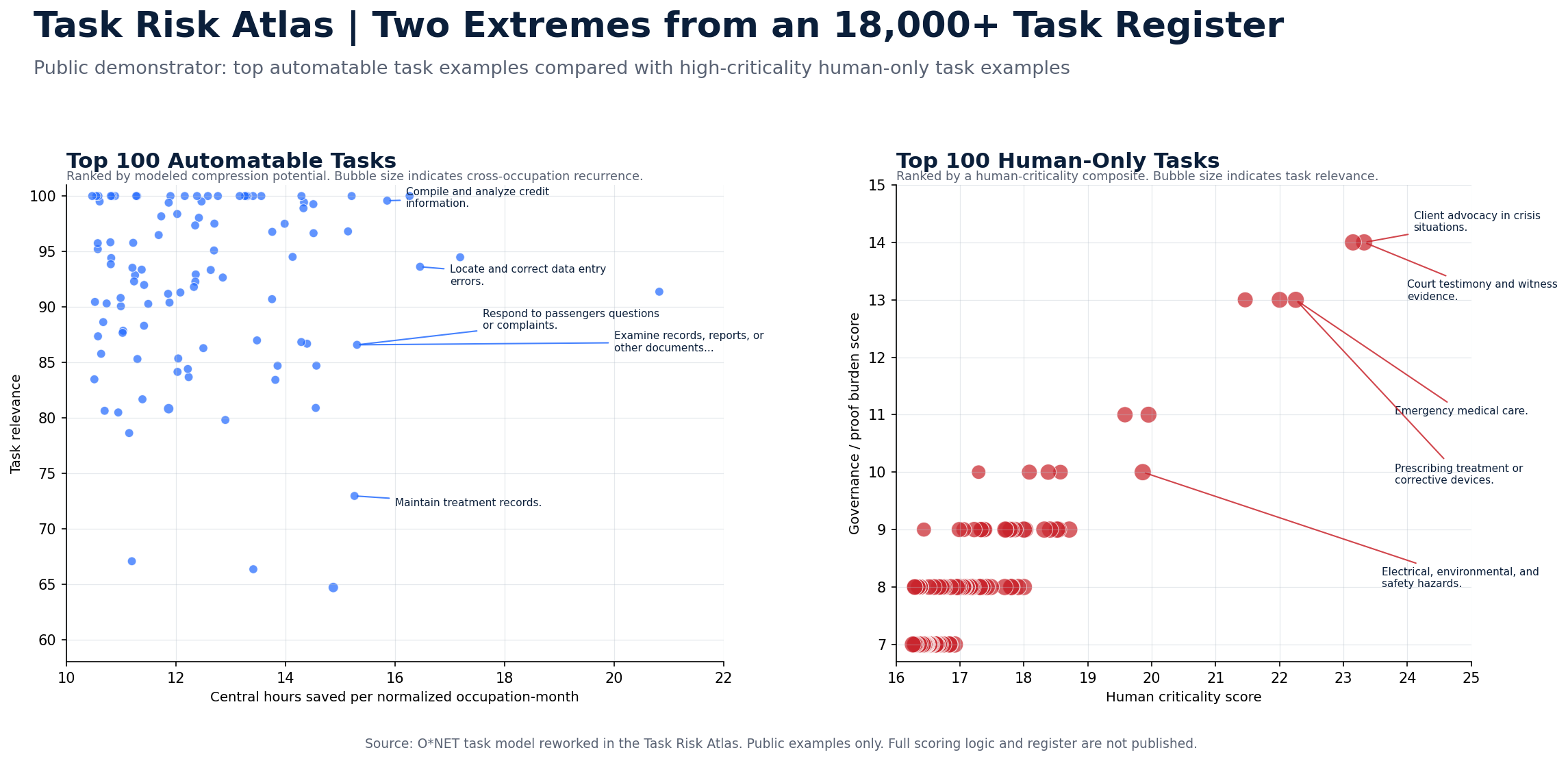
Occupation rankings are useful headlines but weak operating tools. The Atlas moves below the job title to show where AI pressure concentrates inside the work itself, where the opportunity is real, and where governance becomes more important rather than less.
Compression potential
Where AI may reduce task time, accelerate preparation or shift routine production into controlled workflows.
Proof burden
Where AI use creates checking, review, documentation, audit, escalation or accountability requirements.
AI mode
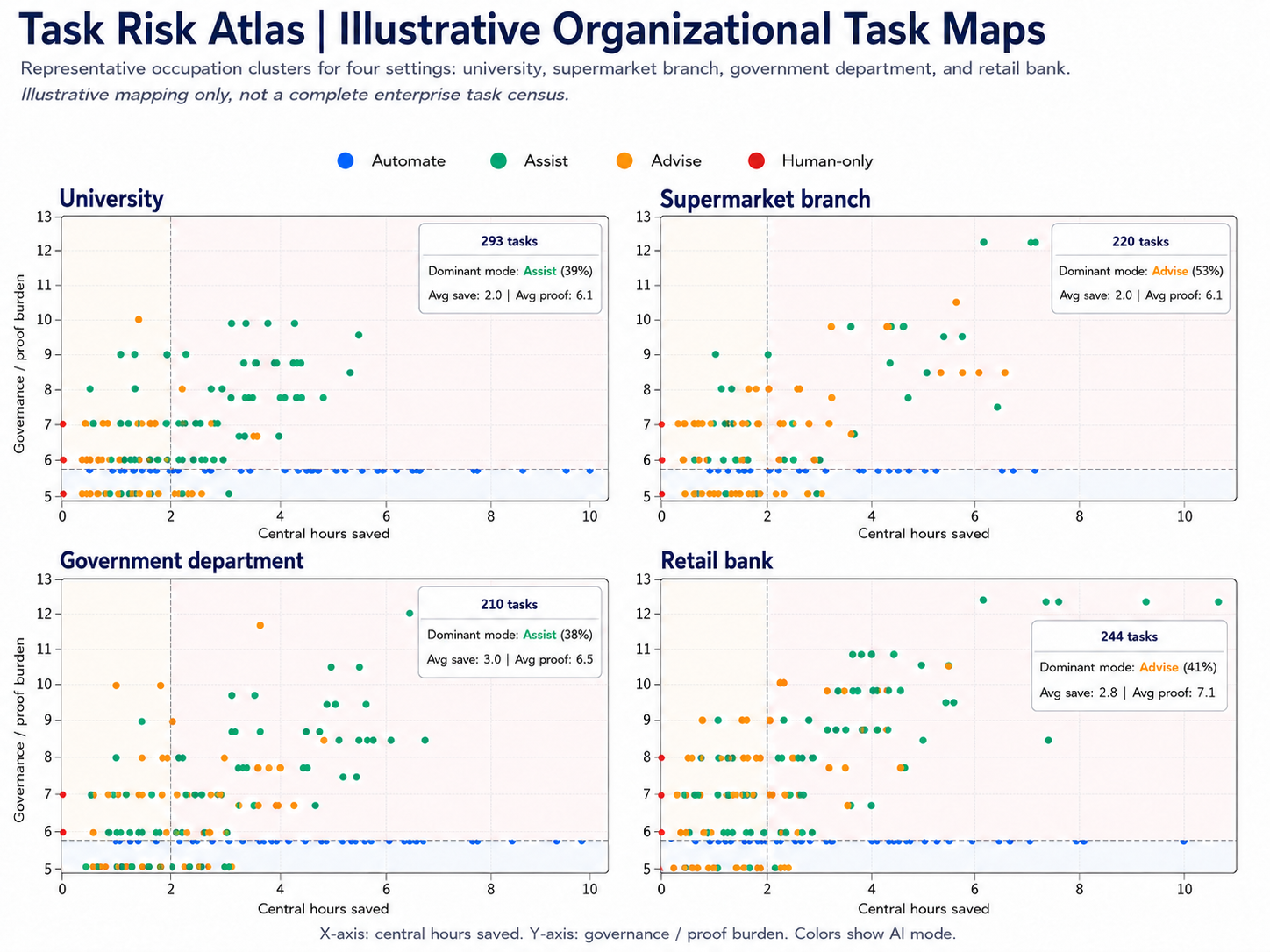
Whether a task is better treated as Automate, Assist, Advise or Human-only under a defined scenario.
Human criticality
Where care, safety, judgment, legitimacy, legal standing or visible responsibility remain central.
Structured records
Records, reports, discrepancies, data correction and structured document handling often show high compression potential.
Assisted professional work
Drafting, search, synthesis, review and preparation may be highly assistable while humans remain accountable.
Crisis, care and safety
Some tasks remain human because the central issue is responsibility, embodied action, trust or professional duty.
Work Rebundler
Once the task map is visible, the useful question is no longer “what percentage of this job is exposed?” It is “what happens to the role when some tasks compress, some become AI-assisted, and others become more valuable because they remain distinctly human?”
Mixed task portfolio
- Routine production and documentation
- Analysis and preparation
- Judgment and decision support
- Relationship and accountability work
Tasks separate
- Automate bounded repeatable work
- Assist synthesis and preparation
- Advise on higher-stakes judgment
- Keep critical human work explicit
Rebundled work
- Less routine production
- More verification and exception handling
- Higher-value judgment and coordination
- Clearer responsibility boundaries
Interactive role upload is temporarily offline.
The earlier prototype generated a first-pass task map from a pasted job description. That requires a paid model API. Rather than leave a dead interface in place, Build 1 keeps the method and worked outputs visible while the live generator is redesigned.
Five occupations. Five different task-risk shapes.
The examples span executive work, knowledge work, people work, controlled finance work and frontline service. They illustrate the deeper Workbench logic: task decomposition, AI mode, residual effort, proof burden, controls and role rebundling.
Chief Executives
Low automation, high augmentation and high accountability.
Management Analysts
High augmentation with medium automation potential.
HR Specialists
Assist-heavy work with legal and ethical sensitivity.
Accountants & Auditors
Automation potential bounded by verification and audit-trail logic.
Customer Service
Higher automation potential with escalation-led human work.
Move from AI enthusiasm to operating-model discipline.
AI-OS is designed for organizations that need to identify credible pilot zones, define automation boundaries, understand the proof burden created by AI use, and redesign work without collapsing capability into a single exposure score.
Task mapping
Build a defensible task register from roles, workflows and local operating context.
Pilot selection
Find bounded, reviewable tasks where compression potential is meaningful and controls are feasible.
Governance boundaries
Specify where AI may automate, assist or advise and where work should remain human-only.
Proof-burden mapping
Identify verification, review, audit, escalation and accountability work created by AI use.
Workflow redesign
Rebuild processes around the new allocation of human and machine work rather than bolting AI onto old routines.
Workforce redesign
Use created capacity to rebundle roles, strengthen judgment and move human effort toward higher-value work.
Discuss an AI-OS diagnostic
For organizations, universities and public bodies that want to move from broad AI adoption claims to a task-level operating model.